Vancouver Fire and Rescue: Early Days
On May 28, 1886, Vancouver’s first fire department was formed. Sixteen days later, the little city burned to the ground. In the 45 minutes it took for the town to burn that day, Volunteer Hose Company No. 1 was helpless—it had no fire engine. City council had ordered equipment from the John D. Ronald Co. of Brussels, Ont., but it hadn’t arrived yet. The two dozen volunteers were equipped with nothing but axes, shovels, buckets and enthusiasm. Sadly, it wasn’t enough.
There had been hundreds of buildings in Vancouver, virtually all of them of wood, and scarcely half-a-dozen survived the fire.
The Ronald engine, christened the M.A. MacLean in honor of Vancouver’s first mayor, arrived at Port Moody in July, a little more than a month after the fire, and was hauled by a four-horse team over miles of dusty roads to Vancouver, via New Westminster. With its accompanying four hose reels, and 2,500 feet of 2½-inch hose, it had cost $6,905.
For the first eight or nine months of its service, the volunteer men of Company No. 1 had to pull the rig themselves to the city’s various fires—they had no horses.
On the night of Aug. 12—in the equipment’s baptism of fire—they hauled it to the Joseph Spratt Oil Refinery, burning furiously on Burrard Inlet, near the foot of what now is Burrard Street, “a considerable distance from town.” It was late at night, uphill much of the way, the equipment weighed well over a ton and the trails to the refinery were rough. Understandably, the men arrived too late to save it. They were able, however, to protect nearby houses menaced by flying sparks.
The story is told in a book, It Began With a Ronald, by Alex Matches, the unofficial archivist of Vancouver’s fire department and a man who is inured by now to jokes about his name.
![1907 Seagrave Firetruck
[Photo: Vancouver Fire and Rescue Services]](https://vancouverhistory.ca/wp-content/uploads/2021/01/trk_1907.jpg)
[Photo: Vancouver Fire and Rescue Services]
Alex’s book follows 90 years of the history of the VFD from its 1886 origins to 1976, concentrating on the equipment used during those years. There are more than 200 photographs. (Most of its sales are via mail order from fire equipment buffs outside Canada, Alex tells me. One outfit in Paris has been ordering copies ever since the book first came out in 1975!)
Alex worked out of Firehall No. 5 in southeast Vancouver and I talked to him there about those early days. I learned that, by 1890, it was possible to turn in fire alarms from a new network of street boxes located throughout the city. There were 15 of them. (Today, there are several hundred.)
I also learned that, up until the fall of 1899, the chief of the fire department, John Howe Carlisle, and his engineers—the men who fired up and operated the equipment—were paid a small salary but the firefighters themselves were still unpaid volunteers. In September of 1899, however, under Carlisle, the VFD became a fully paid department and its 22 men began to receive $15 a month.
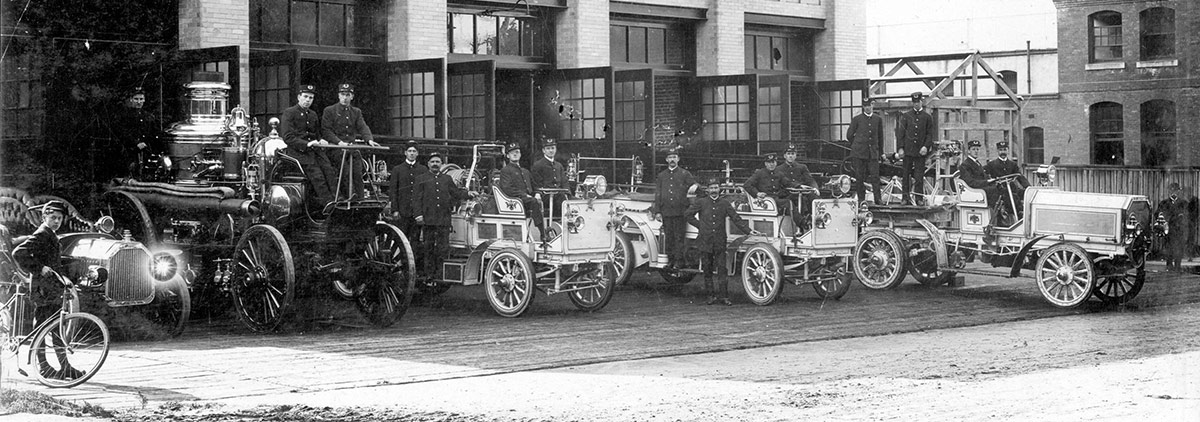
Carlisle seems to have been a far-sighted man. In 1907, he arranged to have three motorized fire-fighting units purchased, in the face of some amused, some not-so-amused opposition. This was a daring move, in fact. The firm making these units—the Seagrave Co. of Columbus, Ohio (still in business, by the way)—had just begun their manufacture and very few fire departments in North America were making the switch.
“I think Carlisle was persuaded to go motorized,” Alex told me, “because he was one of the first people in Vancouver to own an automobile, It was a two-cylinder McLaughlin-Buick touring car and Carlisle was impressed with how quickly he could get around in it.”
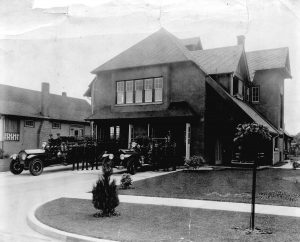
Image: City of Vancouver Archives
The VFD was launched on a career of innovation in training methods and the purchase of new equipment. (This, says Matches, is no empty puffery. In 1911, the Vancouver department was ranked, by a committee of international experts, as among the “world’s best in efficiency and equipment,” and in 1917 became Canada’s first completely motorized department. As a tribute to Carlisle, the city’s first fireboat was named for him.)
With the switch to motorized equipment, a lot of the old-timers were sad to see those horses go and were vastly amused to discover that, for a long time after the mechanization of the department, those same horses—sold to various local companies to pull milk and bread wagons and the like—were disregarding their drivers’ commands and galloping off to fires at the sound of the bells.
In fact, Alex told me, there is a legend that one junk-wagon horse, an old VFD favorite, happened to be hauling his wagon past No. 1 Station when the fire bell began to ring and, in a lather of excitement drove—complete with wagon and a hollering junk dealer—off the end of a wharf into Burrard Inlet.
Today, with 20 firehalls, more than 900 men and a fleet of powerful equipment, the Vancouver fire department—or, to give it its formal name, Vancouver Fire and Rescue Services—has come a long way from that early Ronald.
And Alex Matches has a new book coming out this year with more history on the department’s past.
![RMS Empress of Japan in original appearance [Image: Wikipedia]](https://vancouverhistory.ca/wp-content/uploads/2021/01/1280px-Empress_of_Japan_docked_at_Vancouver_circa_1930s-390x205.jpg)