1922
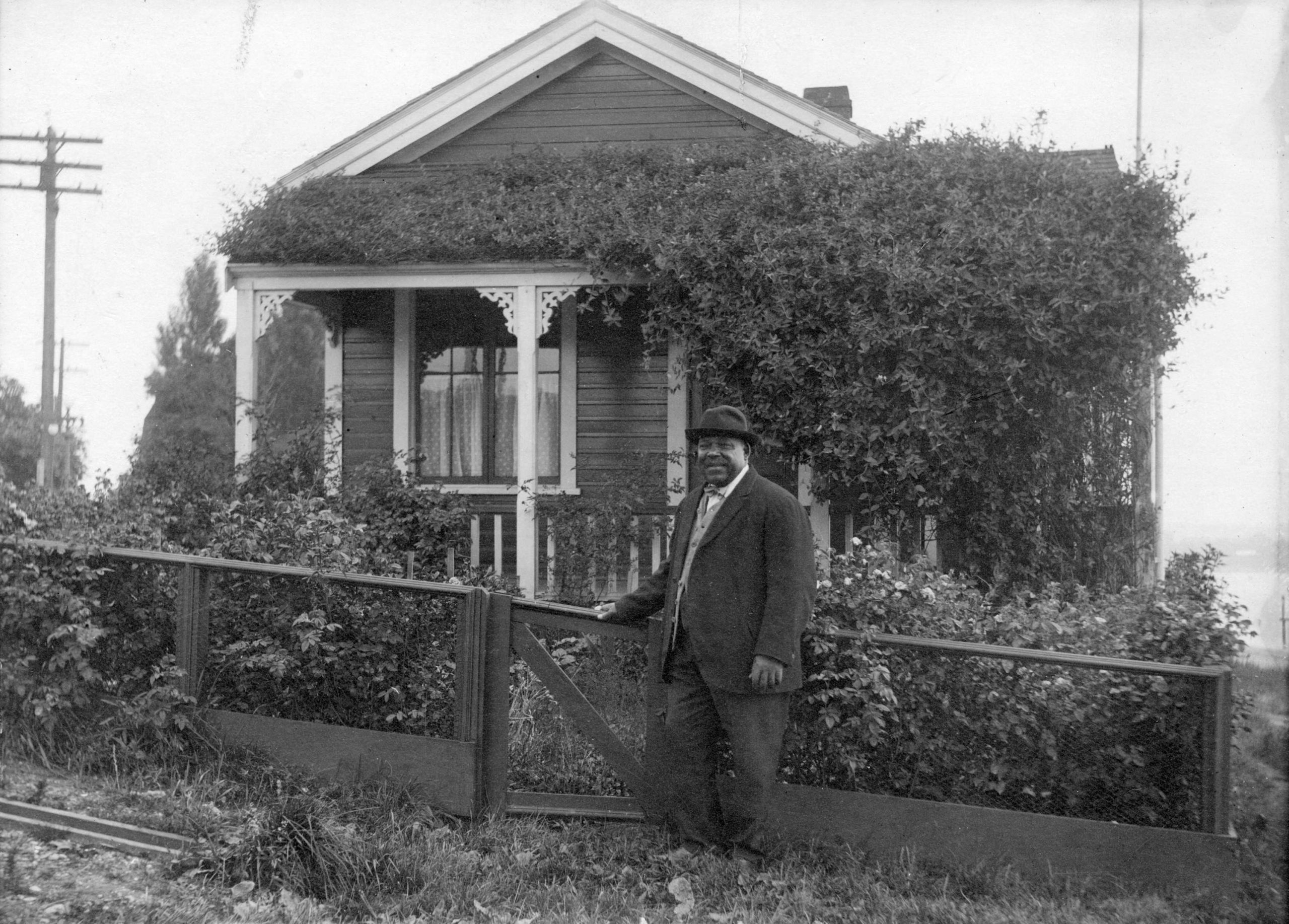
Above: Joe Fortes in front of his cottage on English Bay at the foot of Bidwell Street (1700 Beach Avenue) circa 191?
[Image: City of Vancouver Archives CVA 1184-706]
*****************************************
You’ll note that these years include events listed under “Also in . . .” These are events for which we don’t have a specific date. If YOU know the specific date of an event shown there, please notify us . . . and cite the source! Many thanks!
*****************************************
January 1 At 2:00 a.m. motor vehicles in British Columbia changed from driving on the left to driving on the right hand side of the street. The change went surprisingly smoothly; there were no accidents.
February 4 Joe Fortes, celebrated English Bay lifeguard, died, aged about 57. His funeral at Holy Rosary Cathedral was the most heavily attended in Vancouver history to that time, with thousands outside the packed church. A small fact about Joe that stays with you: he had, for all his life, one small well-thumbed book by his bed, apparently the only book he ever read: The Imitation of Christ by Thomas à Kempis. Joe arrived in Vancouver in 1885, aged about 20 (he was Barbados-born), as a crewman aboard the Robert Kerr. He jumped ship to settle here and, being an excellent swimmer, began to teach local people, especially kids. He taught hundreds and hundreds of them to swim, and they loved him for it. Credited with more than 100 rescues, in 1986 Fortes will be named “Citizen of the Century” by the Vancouver Historical Society.
February 15 The investment firm of Odlum Brown was incorporated.
February 16 Radio personality Jack Cullen was born.
February 18 Brothers M.J. Lannon and P.J. Ryan founded Vancouver College.
February 21 Toronto-born James Welton Horne died in Vancouver, aged 68. He moved to Coal Harbour in March 1885, after business success in Manitoba, and invested in real estate. He profited as the CPR approached. As founder of the B.C. Electric Railway, he developed the street railway and interurban between New Westminster and Vancouver. Over his career, he was a Vancouver city councillor, a provincial MLA, and a parks board commissioner.
March 15 According to local radio buff Brian Walks, Vancouver’s first radio station, CJCE, run by the Vancouver Sun, signed on today. The first night’s programs featured a “Digest of the world’s news” at 8 p.m. followed by music from 8:30-9:30 p.m. The station shut down in 1923.
March 18 The Vancouver Province started testing its new radio service with a newscast at 8:30 p.m. The original signal was heard as far away as High River, Alberta. Originally “Station FB,” with its transmitter in the Merchant’s Exchange Building, it became CKCD in 1923.
March 22 The Weekly Optimist began publishing in Delta, operated by the Dunning family. It will become the Delta Optimist.
March 23 The Vancouver Daily World newspaper launched its new radio station at 2 p.m. with news and stock market reports. There were news bulletins throughout the day, followed by music. Sign off was at 10 p.m.
March 31 William Henry Armstrong died in Vancouver, aged 64. He was born September 18, 1857 in Stratford, Ont. After 1902 his firm, Armstrong, Morrison & Balfour, built the Fraser River bridge at New Westminster, Great Northern Railway bridge across False Creek, and early Granville and Main street bridges. Armstrong paved many of Vancouver’s streets. He caused a sensation in Vancouver in 1899 when he brought in the first gas-powered automobile.
March After the establishment of government-owned liquor stores in B.C. in 1921, they flourished. There were 51 stores by March, 1922, including seven in Vancouver.
April 10 Sprott-Shaw Schools of Commerce & Wireless Telegraphy and Radio Specialties Ltd started CJCE on AM 750 with 5 watts of power.
April 15 Lorraine McAllister, singer and actor, was born in Saskatoon.
April 20 Radio Specialties Ltd. opened CFCQ in Vancouver using 40 watts of power.
April 24 Thomas Ladner, farmer and salmon canner died at age 84 in Vancouver. Born at Trenant Park in Cornwall, England, he came to B.C. in 1858. In 1868, with his brother William, he was the first to preempt land on the site of Ladner.
May 1 Victoria, spurred by a request from the Vancouver School Board, took over the education of both the deaf and the blind children of the province. And they found a building for the new school, too. On May 1 the deaf students, 62 of them, moved in. The blind kids followed in September. The British Columbia School for the Deaf and the Blind had begun.
Also May 1 Richmond’s first May Queen, Violet Thompson, was crowned at Brighouse Park.
May 29 The Norsal, built to carry Powell River Co. executives to the company’s mill, made her maiden voyage from Vancouver.
June 22 Ontario-born grocer Robert Kelly died in Vancouver, aged about 60. He came to Vancouver in 1890 and worked for Oppenheimer Bros. He was the co-founder in 1896 of Kelly, Douglas & Co. Ltd., wholesale grocery firm on Water St. in Gastown. In 1901, his partner Frank Douglas drowned en route from Skagway to Vancouver when his ship hit an iceberg and sank. Frank’s brother Edward took over his role in the company. The firm introduced their own coffee in 1896, and its trade name, Nabob, became a household word. Kraft bought the brand in 1994, and it’s now the second-biggest selling roast and ground coffee brand in Canada.
June 24 Restaurateur Frank Baker was born in Vancouver.
July 22 George Henry Reifel was born in Vancouver. In 1972, he will donate a portion of Reifel Island to the Crown to maintain the George C. Reifel Migratory Bird Sanctuary, named for his father.
September 12 William Farrell, the first president of B.C. Tel, died in Vancouver, aged about 68. Born in Huddersfield, Eng., he came to Vancouver in 1891 and with associates formed the nucleus of the B.C. Telephone Company. In 1948, the William Farrell Building (Seymour and Robson) was built as B.C. Telephone’s head office.
September Johan (Johannes) Buntzen, the first general manager of the B.C. Electric Railway, died in Copenhagen at age 63. He came to Vancouver in the early 1890s, managed early development of the BCER from 1897. He supervised Buntzen Lake engineering and electrical work, and was in charge of the Lake Coquitlam powerhouse that provided Vancouver’s electricity. He resigned from BCER in 1909 and retired to Copenhagen, his birthplace.
October 9 Robert McBeath, who had won the Victoria Cross in action in France in 1917, and was now a Vancouver police constable, was shot to death by a criminal. There is an excellent article by Sgt. Steve Gibson at the Vancouver Police Department Memorial site (click here to view article). It describes the shooting, tells how McBeath won the VC, and describes his funeral, one of the largest in the city’s history.
October 28 Students at the University of B.C., frustrated over endless delays by the provincial government in moving them out to their new (and uncompleted) campus at Point Grey, took part in the “Great Trek” today. Nearly 1,200 of them, angry at having to study in the big and drafty “Fairview shacks” on Willow Street, paraded through downtown Vancouver streets—led by the band of the Irish Fusiliers. The students then boarded streetcars to take them to Alma Road (now Alma Street) and the gates of the campus. The male students boarded Broadway West streetcars, while the women went on 10th Avenue cars. They continued their procession along the dirt trail that led through the forest to the unfinished site, joined forces at Point Grey and formed a huge “UBC” with their bodies for the benefit of photographers. The government responded by authorizing a $1.5 million loan to resume construction. But it was still 1925 before the students could finally move in.
Fall Sumas Lake was pumped dry and the fertile land beneath claimed for farming. It will become the richest, most efficient dairy, berry and hop-growing region of the province.
December 11 Pauline Jewett, SFU President from 1974 to 1978, was born in St. Catharines, Ont. She came west to be president of SFU (1974-78), the first female president of a major Canadian university. A good, brief bio here.
December 15 It became the law: women could now serve on juries in B.C.
December 21 Isaac Oppenheimer, Vancouver businessman, died in Spokane, Washington. He was one of the four Oppenheimer brothers who thrived here. In 1886 he opened a wholesale grocery warehouse in the Oppenheimer Bros. Building (Powell and Columbia), Gastown’s oldest brick building, now owned by singer Bryan Adams. It became B.C.’s largest business of its type, and exists today as The Oppenheimer Group, Vancouver’s oldest locally-owned company. Isaac was an alderman from1887 to 1889, with some of his term overlapping with his brother David’s mayoralty.
Also in 1922
After his wife Grace died, realtor Henry Ceperley sold their home, Fairacres, at Deer Lake in Burnaby and used the money to build Ceperley Playground in Stanley Park. (Fairacres is now the home of the Burnaby Art Gallery.)
In a move to curtail Japanese fishermen, fishing licences to “other than white, British subjects and Indians” were cut by up to 40 per cent. The Japanese fishermen took their case to court and won, but the government enacted legislation to allow the discrimination to continue. (The case went to the Privy Council in England in 1929. The fishermen won, but by then only half remained.)
A memorial to poet Pauline Johnson was unveiled near Ferguson Point in Stanley Park. It was carved from natural rock by James McLeod Hurry. The Women’s Canadian Club had begun raising funds in 1913 for this cairn, which marks the resting place of the Mohawk poet’s ashes. Incidentally, Johnson specifically decreed in her will that no memorial be raised.
Electric power came at last to West Vancouver after seven years of appeals to the B.C. Electric Company.
Pacific Stages Transport began a bus route from Vancouver to Port Moody and Port Coquitlam. (Later the service was extended to Haney and will eventually become Pacific Stage Lines.)
Charles Edward Tisdall became mayor of Vancouver. He was a walnut farmer. Tisdall became the only mayor selected under the system of proportional representation, in which the candidate for city council who got the most votes became mayor. He succeeded Robert Gale.
The Shaughnessy Heights Building Restriction Act, which prohibited the division of single family dwellings into apartments or housekeeping rooms, was passed in the provincial legislature.
There was one automobile for every 12 people in Vancouver.
Jake Grauer established the Frasea Dairy Farm on Sea Island. It became Richmond’s largest dairy farm, at one time numbered 500 cows. The farm was shut down in 1954 to make way for the expansion of the Vancouver International Airport.
Historian Cyril Leonoff writes: “Benny Kubelsky was playing the Orpheum circuit in 1922, along with the Marx brothers, and accompanied Zeppo Marx to a family Passover seder in the home of David Marks, a Vancouver tailor. There he met the Marks’s daughter Sadie. The couple married in 1927 and in the heyday of radio, under the stage names of Jack Benny and Mary Livingstone, became a world-renowned comedy team.”
The B.C. Electric formed its own intercity bus operation, B.C. Rapid Transit.
Rob Morris and Len McCann have written that the wooden-hulled tug Master was built this year in Arthur Moscrop’s False Creek Shipyard. “Presently maintained by an enthusiastic non-profit society, Master attends maritime festivals as a representative of the pioneering steam towboating era of the first half of the 20th century.”
Baseball’s Vancouver Beavers of the four-city Northwestern League disbanded. They had won pennants in 1911, 1913 and 1914, then went into decline. They played at Athletic Park, at West 7th and Hemlock.
Tom Fyles, a postman, became the first person to complete a winter ascent of the Lions.
Canadian Pacific’s Empress line of steamships ended its service. The Empresses had been crossing the Pacific to the Orient and Australasia since 1891. Empress of Japan, which had arrived in Vancouver June 22, 1891 crossed the Pacific 315 times—setting trans-Pacific speed records that were unchallenged during 22 years of her active career—and steamed more than four million kilometres (2.5 million miles.) She will sit in Vancouver’s harbor for four more years before being sold.
Sports writer Jim Kearney was born.
Novelist and screenwriter Ernie Perrault was born.
Historian Frederick Hubert Soward, 23, began teaching in UBC’s history department. In his early years he was known as “the boy wonder.” He will keep at it until1966, headed the department from 1953 to 1963.
Anne Margaret Angus wrote the first UBC student play (The High Priest) performed by the University Players’ Club.
Vancouver’s first Good Citizen Award was given to fire chief John Howe Carlisle.
The Vancouver Business and Professional Women’s Club was founded.
Ontario-born Gordon Wismer, who had arrived in Vancouver in 1907, began his own law firm in Vancouver, aged about 34. He became one of B.C.’s best-known criminal lawyers, would go on to become the province’s attorney-general.
With her husband Ephraim, Anne Sugarman founded the Reform Jewish Sunday School. She had a full life, detailed in Pioneers, Pedlars, and Prayer Shawls by Cyril Leonoff.
Minnesota-born George Frederic Strong, 25, began to intern at Vancouver General Hospital. He will become internationally known as a heart specialist. The G.F. Strong Centre is named for him.
Scotland-born future senator Thomas Reid was elected a councillor in Surrey.
Radio CHLS founded by William Hassell. It was renamed CKCD and run by the Daily Province.
Arthur William Delamont, 30, came to Vancouver. Born in Hereford, England, as a young man he was active in the Salvation Army Band in Moose Jaw, Sask. After his arrival here, he played trumpet at the Pantages vaudeville theatre. He will become famous as the organizer and conductor of the Kitsilano Boys’ Band.
The vaguely castle-like building on the east side of Main at East 15th, which began life in 1915 as Postal Station C, became the Dominion Agriculture Building. (Today, it’s called Heritage Hall.)
H.R. Budd became president of the Vancouver Real Estate Board.
The Vancouver Information and Tourist Association changed its name to the Greater Vancouver Publicity Association.
(Around 1922) Realtor Ernest Leonard Boultbee, with a partner, formed Allan & Boultbee Ltd. It will merge with Macaulay, Nicolls & Maitland around 1926.