1993
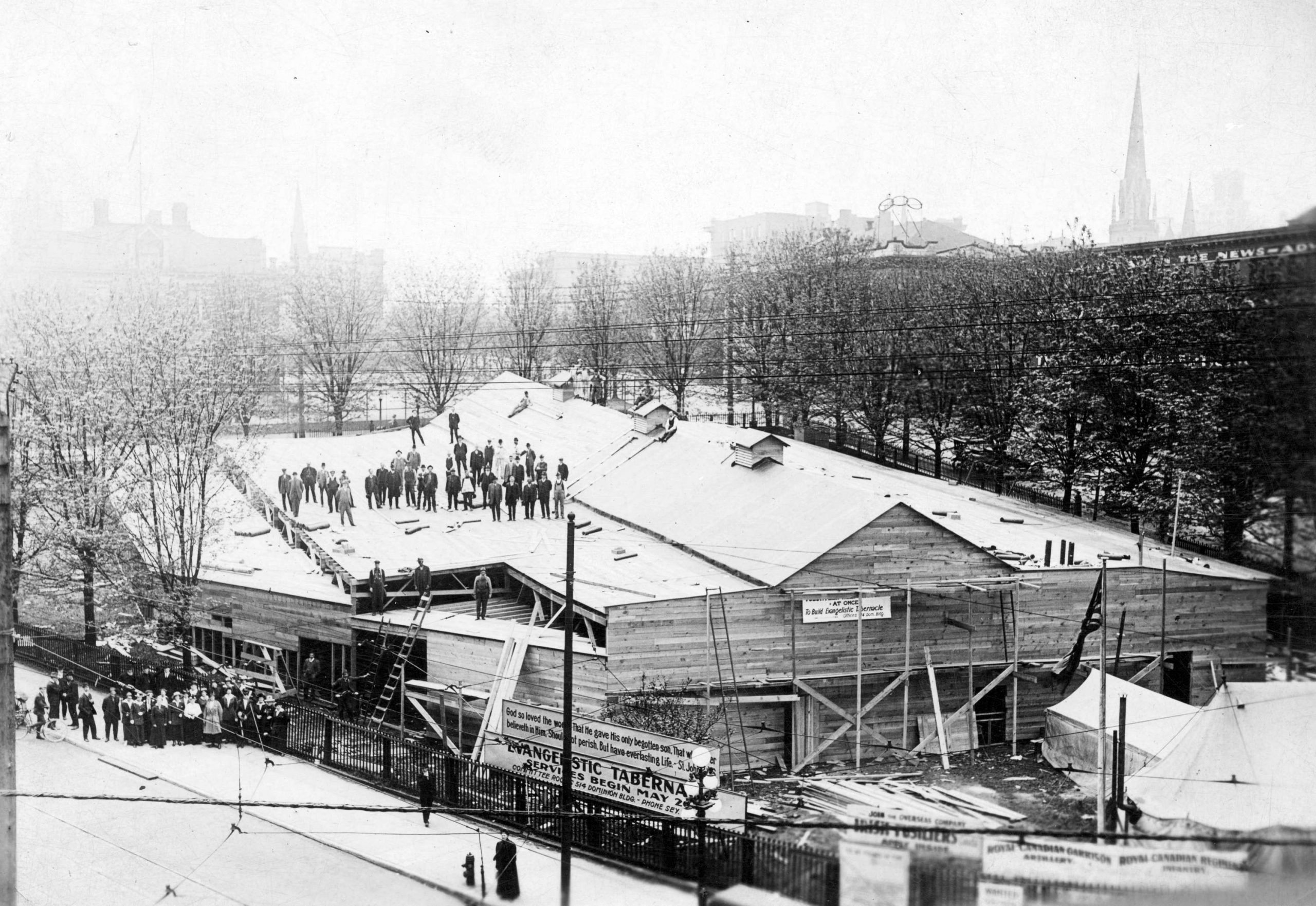
Above: The Evangelistic Tabernacle at 85 East 10th Avenue was built 1909-10. It was designated a Schedule A heritage structure in 1993.
[Image:Vancouver City Archives AM54-S4-: Bu P173]
*****************************************
You’ll note that these years include events listed under “Also in . . .” These are events for which we don’t have a specific date. If YOU know the specific date of an event shown there, please notify us . . . and cite the source! Many thanks!
*****************************************
January 1 Czechoslovakia peacefully spilt into two countries, the Czech Republic and the Slovak Republic.
January 15 Woodward’s, a retail institution in Greater Vancouver for more than 90 years, closed its original downtown store at Hastings and Abbott. The demise of the company would follow in June when it declared bankruptcy. There is a short, but detailed history of the company from its origins to its demise here. An excerpt (picking up from 1957 when Charles “Chunky” Woodward took over): “For the first 25 years of Chunky’s rule, Woodward’s blossomed into a major player on the retail scene of Western Canada. No fewer than 18 stores opened in cities throughout B.C. and Alberta, often as anchors in very important shopping centres such as the Chinook Centre and Market Mall in Calgary, or the Southgate Centre and the Edmonton Centre. Sales increased by a factor of more than 10, from under $100 million to well over $1 billion, thanks to unprecedented favourable economic conditions.
“The arrival of the 1980s put a stop to all that. The recession hit Woodward’s harder, perhaps, than any other retailer. The rapid expansion of the preceding years, including the opening of 4 stores in 1981 alone, left the Company financially fragile at a time when a combination of high inflation, high interest rates and large debt exerted pressure on customers as well as retailers. In a bid to improve its situation, Woodward’s immediately began disposing of assets to lower its liabilities and improve cash flow. Some surplus land and buildings were sold, and various cost-saving measures were implemented . . .” And so on. See the cited web site for more.
The famous big “W” sign atop the store was a landmark which the people of Vancouver refused to lose. Woodward put a lofty tower atop his store in 1923. It was 75 feet high, patterned after the Eiffel Tower, and topped with a big revolving searchlight that could be seen as far away as Vancouver Island. At the base of the tower a huge letter W sat. When the Second World War started the federal government ordered the light removed, so in 1944 Woodward put the W—16 feet high and weighing three tons—on top of the tower.
It’s been up there ever since. After repairs it will once again be aloft over the redevelopment of the building. Rennie Marketing Systems has an elegant web site on the development here and the “W” gets star attention.
January 28 Mandrake the Magician (Leon Mandrake), entertainer, died in Surrey, aged 81. He was born April 11, 1911 in New Westminster, and was raised there. At age eight he performed at the Edison vaudeville theatre and New Westminster’s Civic National Exhibition. From 1927 he toured North America with his magic show. By the 1940s he was a top box-office draw. He married his wife and partner/assistant, Velvet, in Chicago in 1947. They toured worldwide, setting the trend for large, elaborate illusion shows; he was the first magician to play nightclubs. In the 1950s he had two TV series and performed on the CBC. Mandrake lectured at Canadian universities in the 1970s. Whether he inspired the popular comic strip, Mandrake the Magician (which premiered in 1934) or it inspired him is a subject of interest to entertainment buffs to this day. This website says the strip’s creator, Lee Falk, had the original idea in 1924 . . . meaning the comic strip was first. But then, there’s this site which says Leon Mandrake had been performing for well over ten years before Lee Falk introduced the comic strip character.
January The Spirit of British Columbia, an ‘S’ class “superferry,” was launched this year for the BC Ferry Corporation. It measured 167.5 metres (550 feet) long and could carry 2,052 passengers (and 48 crew) and 470 vehicles, representing “a new generation of ferries on the West Coast.” Her service speed is 19.5 knots, and she travels regularly on the Tsawwassen to Swartz Bay route. The European design was built in five modules by three shipyards—Allied Shipbuilders and Pacific Rim Shipyards of Vancouver and Integrated Module Fabricators/Yarrows in Victoria—then joined together. The Spirit of Vancouver Island would be launched in 1994.
January Designated a Schedule A heritage structure was Taylor Manor at 951 Boundary Road, built in 1913. It was intended as a residence for the then Mayor, Louis D. Taylor, but soon after its completion became the Vancouver Old People’s Home, and later became known as Taylor Manor. It would remain a seniors residence until the 1960s when it became a 58-bed licensed care facility for seniors operated by the City. Designated a Schedule B heritage structure was St. George’s School, at 3851 West 29th, built in 1911-12.
January The British Columbia Psychological Association, a voluntary association of registered psychologists, was reinstated “to give a separate voice to the concerns of the profession without compromising the public purposes of the original society after it was tasked by the Province (and name changed to College) to register and regulate the activities of psychologists. The association promotes psychology as a profession and a science, provides a referral directory for the public, arranges continuing education training for psychologists and other interested health professionals, and has developed a network of registered psychologists to respond to community needs in the event of natural or other disasters.” They quote Woody Allen on their website: “I never get angry. I just grow a tumor instead.”
February 1 Harold Winch, politician, died in Vancouver, aged 85. Harold Edward Winch was born June 18, 1907 in Loughton, Eng. His father was labor leader Ernest Winch. Harold arrived, aged about 3, with his family in 1910. In 1933 he was elected CCF MLA for the working class riding of Vancouver East, and represented it for 20 years. He was leader of the provincial CCF party from 1938 to 1953, and Leader of the Opposition from 1941 to ’53. He came close to being elected premier in 1952. A bitter rival of W.A.C. Bennett, it was Winch who coined the nickname ‘Wacky.’ Winch served as the CCF/NDP MP for Vancouver East from 1953 to 1972, an astonishing record of 39 years as a political representative for that neighborhood.
February 6 Barney Potts, entertainer, died in Vancouver, aged 82. He was born April 25, 1910 in Harrogate, Eng. He led bands in the 1930s in Vancouver nightspots like the Alma Academy, Happyland, Cinderella Ballroom, the Quadra Club, Mandarin Gardens, Odyssey Room and The Narrows. He performed in musicals in the 1940s, and spent 12 years with Theatre Under the Stars. Accompanied by his wife, singer Thora Anders (b. Sept. 12, 1913, Victoria), he played radio and TV (such as a Juliette special with Robert Goulet), nightclubs and concert halls. He was with us for a long time. From Page One of the Ubyssey of November 22, 1932: “Wednesday afternoon the Pep Club under Gordie Hilker and Lyle Stewart will ring the bell once again when they present for the entertainment of the students Barney Potts and his orchestra, undoubtedly the peppiest aggregation of rhythm-dispensers in British Columbia.” In 1980, at the age of 70, he released an album titled Barney Potts, Live—Just Barely. Barney was inducted into the Orpheum Theatre’s Entertainment Hall of Fame in 1990.
February Vancouver City Council approved the creation of a Task Force on Employment Equity for Persons with Disabilities. Its mandate was to develop an action plan with well-defined goals, a timeline and an evaluation process for achieving representative hiring and promotion of persons with disabilities in the civic workforce. It would report in 1995.
March 27 The beautifully reconditioned Parker Carousel, built in 1912 in Kansas, was set in motion at Burnaby’s Heritage Village. The carousel had given pleasure to PNE Playland visitors for more than 50 years. That sunny photo to the right comes from the Greater Vancouver Distance Education School.
March Former president of the Soviet Union Mikhail Gorbachev participated in a student forum at Vancouver’s Expo Centre prior to speaking at a fund-raising dinner for Science World. Dr. Stephen Hawking, the famous physicist, would visit in June to talk with some 150 disabled students about how he manages his disability—the life-threatening disease amyotrophic lateral sclerosis (ALS).
March B.C. Research, incorporated as a private company in 1988, was declared insolvent. The provincial government created a fund to keep it going, and—while the employees stayed on without pay—looked for a buyer. They found one three months later, a consortium of three companies (Terracy Inc., Noram Engineering and Constructors Ltd., and Stothert Group Inc.) that paid $2 million for the company’s assets, including its 180,000-square-foot facility (at 3650 Wesbrook Mall) and previously-signed contracts. The president of the new company, christened BCRI, was Dr. Hugh Wynne-Edwards, Terracy’s president. Wynne-Edwards, the head of UBC’s geology department in the early 1970s, also had extensive experience in government and private industry, including an Alcan vice-presidency and the presidency of Moli Energy. Today, the company is known as Kemetco Research Inc..
March One small group within the GVRD starts being interested in you the moment you’re born: in March 1993 the Birthing Centre Working Group (BCWG) arranged for a telephone survey of 900 women of childbearing age who lived within the GVRD. The purpose was two-fold: to measure the level of interest in using a birthing centre, and to determine the services preferred. Some 77 per cent of the women surveyed expressed interest in a more family-focused centre, rather than the traditional institutional models. The idea, to quote the BCWG, is to “strengthen and empower families around their own health, so that they become partners rather than passive participants in the health care system.” In 1993 there were as yet no birthing centres in British Columbia, although there had been recent developments toward the establishment of hospital-based family-centred maternity care models such as labor, delivery, recovery and postpartum rooms that incorporate a birth centre philosophy.
March Landscape architect Don Vaughan completed the rehabilitation of UBC’s beautiful Nitobe Gardens. It had started in October 1992. There’s an interesting note on the project on the Vaughan website, including descriptions and photographs of other commissions, like the Dr. Sun Yat-Sen Classical Chinese Garden and Park.
April 3 Vancouver hosted a two-day summit meeting between U.S. President Bill Clinton and Russia’s President Boris Yeltsin. This was the first of several summits attended by both men. Most of their sessions here were held in UBC’s Norman MacKenzie House, named for a former president of the university. The 630-square-metre house, built in 1951 and renovated in 1983 in the style of a Spanish villa, is the private residence of the university’s president. (In ’93 that was Dr. David Strangway). You can read a detailed account of the Clinton/Yeltsin deliberations here and there’s a good Washington Post article here.
In front of Seasons In The Park restaurant in Queen Elizabeth Park is a marker noting that Yeltsin and Clinton dined there April 3.
A funny note: Wreck Beach was briefly in the news during the Summit. President Clinton’s advance team discovered, to its horror, that directly below a spot where the two presidents would be strolling were signs showing the way to the nude beach. The signs were immediately covered over.
April 7 A group called the Friends of the City Archives was formed to lobby for support for Vancouver’s archives. They hold regular meetings, sponsor talks, etc.
April Designated a Schedule A heritage structure was Evangelistic Tabernacle at 85 East 10th Avenue, built 1909-10. Designated a Schedule B heritage structure was 5709 Wales, built in 1912
May 1 David Emerson, the president and chief executive officer of the Vancouver Airport Authority, imposed an “airport improvement fee” for departing passengers. ($5 for passengers travelling to a destination within British Columbia or the Yukon; $10 for passengers travelling to other North American destinations, including Mexico, plus Hawaii; or $15 for passengers travelling to destinations outside North America. The fee was to be paid by passengers departing from the airport. Children under two and passengers connecting through Vancouver on the same day—the latter about 30 per cent of all enplaning passengers—were not required to pay.)
In a June 1996 Equity interview with writer Stuart McNish, Emerson would explain the rationale for the imposition of the unpopular fee. Someone, he said, has to pay the $500 million for the airport’s expansion, and it was decided to make the fee visible so the public associates the money with the project. American airports, said Emerson, have similar fees buried within ticket prices. “Under our system,” he continued, “it goes from your hand to the person in the green vest and in 10 minutes it’s been deposited in the Royal Bank and applied to the debt on the new terminal and runway.” Once the additions are completed, he says, the fee will disappear and further expansion will likely be funded by 20-year bonds. (By June 1, 1996, the date the new International Terminal Building opened for business, the AIF program had raised approximately $100 million towards the cost of the building.)
On its website the airport says: “As a not-for-profit organization, the Airport Authority has no shareholders and receives no government guarantees. The Airport Authority re-invests all earnings in airport development and service improvements.”
May 5 Erwin Swangard, sports reporter, newspaper executive and PNE president, died in Vancouver, aged 84. Erwin Michael Swangard was born May 11, 1908 in Munich, Germany. He emigrated to Canada in 1930. As a freelance sports reporter he covered the 1936 Olympic Games for The Vancouver Sun. From 1944 to 1949 he was foreign editor of The Province. Then he went to work for the Sun, worked his way up, and was appointed managing editor in March, 1959. Swangard founded the Tournament of Soccer Champions for juvenile soccer. He promoted the British Empire and Commonwealth Games in Vancouver (1954) and the first Grey Cup final outside Toronto (1955). He was one of seven founders of the B.C. Lions. He raised almost $1 million to build Swangard Stadium, opened in 1969. “Mr. PNE” was appointed president in January 1977, a position he held for 13 consecutive annual terms. In 1989 he was named a Member, Order of Canada.
May 16 The Eileen Dailly Leisure Pool and Fitness Centre opened at 240 Willingdon Avenue in Burnaby. Named for the former MLA, cabinet minister and community activist, the centre had a water slide, children’s water play area, weightroom, child minding space, multipurpose room, whirlpool, sauna, steam room, cafe, etc.
June 2 Larry Lillo, theatre director, died in Vancouver, aged 46. He was born September 20, 1946 in Kinuso, a tiny village in Alberta northwest of Edmonton. He attended Royal Roads Military College, Nova Scotia, earned a BA at St. Francis Xavier. He studied at U. of Washington, then in New York City, later received an MA at UBC in directing. Lillo was the co-founder and a director and actor with Tamahnous Theatre from 1971 to 1981, a freelance theatre director, 1981-85, and artistic director of the Grand Theatre in London, Ont. in 1986. In 1988 he became artistic director of the Vancouver Playhouse (1988). Under his leadership, Playhouse subscriptions rose from 5,800 (1988) to nearly 12,000 (1992/93). He won a Jessie (Vancouver) and a Dora (Toronto) for his direction of Sam Shepard’s play A Lie of the Mind, which was at the Playhouse from October 4 to November 5, 1988. Lillo directed and developed many new Canadian plays. His partner, John Moffat (d. May 16, 1995, Vancouver, at 39), was an award-winning actor.
June 25 Robert H. Lee, a UBC graduate, developer and philanthropist, was elected UBC chancellor.
July 1 The Westbrook Hotel, at 1200 Hornby at Davie, was renamed The Landis Hotel & Suites.
July 10 Anne MacDonald, arts advocate, died in North Vancouver, aged 63. Anne Elizabeth MacDonald was born March 18, 1930 in Vancouver. She established North Vancouver’s Presentation House Arts Centre, and saved the historic Church of St. John the Evangelist as a recital hall (named Anne MacDonald Hall in 1977). She founded the North Vancouver Community Arts Council and the B.C. Arts and Crafts Fair. As the first executive director of the Vancouver Community Arts Council, she set up the Assembly of B.C. Arts Councils. Ms. MacDonald sat on many boards and commissions including the UBC senate, North Vancouver School District and Canadian Conference of the Arts. Member, Order of B.C. In 1990 she received the YWCA Woman of Distinction Award for Community Service. A remarkable woman.
July 28 Ground was broken to begin construction of the Renfrew Branch of the Vancouver Public Library.
July 29 Pacific Forest Products Limited was incorporated under that name. The private timberlands of the company would be acquired by TimberWest Forest Corp. on December 10, 1997.
July Designated Schedule A heritage structures were 3358 Southeast Marine Drive, built in 1911; 3010 West 5th, built in 1921; St. Mary’s Church Kerrisdale’s church building, built in 1913 and the church’s parish hall, built in 1923.
August 4 Woodward Place in New Westminster was renamed Royal City Centre.
August 11 Woodward’s at Guildford in Surrey became The Bay.
August 27 The 200,000th baby was born at New Grace Hospital (now the British Columbia Women’s Hospital and Health Centre).
August A merger of Vancouver General Hospital and University Hospital/UBC resulted in the creation of the Vancouver Hospital and Health Sciences Centre. Wikipedia tells us that today VHHSC is the second largest hospital in Canada, with 1,900 beds and nearly 116,000 patients each year. They employ 9,500 staff and utilize 1,000 volunteers. By 2005, the hospital’s annual budget would be $463 million.
September 11 The municipality of Surrey officially became a city.
September 12 Raymond Burr, actor, died at Dry Creek, California, aged 76. Raymond William Stacy Burr was born May 21, 1917 in New Westminster. He was nicknamed ‘Fatso’ as a child. At age six he moved with his mother to Vallejo, Calif. He began to grow orchids at age 12, eventually shipping 3,000 varieties worldwide. As a young stage actor, he worked in Toronto, New York and England. He served in the navy during the Second World War, was shot in the stomach in Okinawa and sent home. Later, he began to work in movies. The Internet Movie Database lists his first as Earl of Puddlestone (1940). He was the villain in Rear Window (1954.) Burr was famous for his television roles, Perry Mason (September 1957 to May 22, 1966) and Ironside (September 14, 1967 to January 16, 1975). A philanthropist and art collector, especially in Fiji where he owned a home and properties. He is interred in Fraser Cemetery in New Westminster.
September Kwantlen College’s $30.4 million Langley campus opened. Located on a 18.2-hectare site at the Langley Bypass and Glover Road, the facility featured the Provincial Horticulture Training Centre, including a greenhouse and nursery. Other facilities included a 250-seat music performance auditorium, a library and a day care centre. Located on the southwest corner of the campus site and now owned and maintained by Kwantlen University College (the name would change to this in 1995) is the turn-of-the-century Wark/Dumais House, designated a heritage building by the B.C. Heritage Society.
September Designated a Schedule A heritage landscape was the Central Median of Cambie Street Boulevard. Designated a Schedule B heritage structure was the Jones Tent and Awning building at 2034 West 11th Avenue, built in 1919.
From King Edward Boulevard to Marine Drive the central median of the Cambie Boulevard is an important piece of urban planning, envisioned by planner Harland Bartholomew in 1946. Much credit for its preservation was given to Ethel Karmel and Citizens to Save the Cambie Boulevard. A plaque at 33rd Avenue tells the story, and an August 2006 article by Sandra Thomas in The Courier gives more recent information.
October 6 Peter Toigo, entrepreneur, died in Los Angeles, aged 61. Peter Claude Toigo was born September 9, 1932 in Powell River, BC. His parents came from N. Italy. At age seven he sold eggs door-to-door in Powell River. In 1949, at age 17, he bought the Wildwood Grocery and worked there as a butcher. He married his childhood sweetheart, Elizabeth Rowher, in 1950 and completed his first major land transaction. In 1960 he bought downtown Powell River from MacMillan Bloedel and built its first shopping centre. In the mid-1970s his company, Shato Holdings, almost went bankrupt but survived and expanded, buying the White Spot restaurant chain in December 1982. An intensely private man, he was dogged by controversy on labor issues and Social Credit party connections. See the book Triple O, The White Spot Story (1993) by Constance Brissenden.
October 13 UBC professor Michael Smith (born in Blackpool, England in 1932) won the Nobel Prize in Chemistry. There is a fine autobiographical sketch here.
Here’s an excerpt: “The last year of our graduate studies saw me and my classmates writing to various American professors seeking post-doctoral fellowships. I had no luck in obtaining my desire of a fellowship on the west coast of the United States, but I heard, in the summer of 1956, that a young scientist in Vancouver, Canada, Gobind Khorana, might have a fellowship to work on the synthesis of biologically important organo-phosphates. While I knew this kind of chemistry was much more difficult than the cyclohexane stereochemistry in which I was trained, I wrote to him and was awarded a fellowship after an interview in London with the Director of the British Columbia Research Council, Dr. G.M. Shrum. I arrived in Vancouver in September 1956 . . .”
A description of the discoveries for which Dr. Smith won the Nobel Prize is on the Nobel website here.
Dr. Smith’s laboratory was in UBC’s Networks of Centres of Excellence, atop the university bookstore, and it was here he shared a champagne toast with colleagues the day it was announced he had won the Nobel.
The prize was $500,000, but Smith didn’t keep it. He gave away half to the Schizophrenia Society of Canada and the Canadian Alliance for Research in Schizophrenia, then gave away the other half to establish an endowment fund whose income, among other things, helps to support the Society for Canadian Women in Science. Dr. Smith died of leukemia at 68 on October 4, 2000. “A warm and humble man known for his humanity and generosity.”
October 22 Surrey Metro president Lloyd Craig took flak in the fall of 1993 when his credit union proposed a merger with Chilliwack-based First Heritage Savings Credit Union. “At the time,” business reporter Bruce Constantineau wrote, “Surrey Metro had $1.2 billion in assets while First Heritage had $600 million and Craig felt a merger made sense since a combined operation could achieve more economies of scale and be in a better position to compete against larger banks and trust companies. But First Heritage officials viewed the proposal as a hostile takeover and credit union members overwhelmingly rejected the deal—by a vote of 15,930 to 650—following a stormy meeting attended by an overflow crowd of 2,500 people at the Ag-Rec Centre in Chilliwack October 22, 1993.”
October Designated a Schedule A heritage structure was the Toronto Dominion Bank at 560-580 West Hastings Street, built in 1920.
Fall The Royal Vancouver Yacht Club purchased 18 acres in Cortes Bay, on Cortes Island, with approximately 1,300 feet of waterfront. This made seven properties the Club had acquired as Offshore Stations since 1960.
November 12 Gerald Rushton, author and historian, died in Tsawwassen, aged 95. Gerald Arnold Rushton was born July 20, 1898 in Liverpool, Eng. “His interest in marine history,” Constance Brissenden writes, “began in 1913 after winning a scholarship to Liverpool Collegiate School. He took officer training (1915-19), learning world trade shipping. Of the 12,000 students who trained with him, 9,000 died in the First World War. After working with his father, a senior manager in Liverpool’s J.H. Welsford Co., Gerald emigrated to B.C. in 1920 and joined a subsidiary, Union Steamship. His 38 years with the company (as office manager) and knack for research made him a sought after expert on the coast’s maritime heritage. He married Margaret Rushton in 1930, the year she arrived in Vancouver from Wigan, Eng. He wrote Whistle up the Inlet (1974), a history of the Union Steamship Company, and Echoes of the Whistle (1980), an illustrated history of the company.”
November Philip Owen—born in Vancouver March 12, 1933—became Vancouver’s 42nd mayor. He got into politics in 1978 as a park board commissioner, was on council by 1986. Wrote Donna Jean McKinnon in The Greater Vancouver Book (in an article that was published while he was mayor): “He loves surveys that show Vancouver as the best city in the world in which to live. It will, therefore, be particularly galling to him to have to call for police protection at council meetings. A recent achievement is his enlightened Four Pillars Approach to Drug Problems. It ‘integrates prevention, treatment, enforcement and harm reduction,’ focuses on treating addiction as a health problem. Four Pillars brought Owen the BC Provincial Health Officers Award, first ever awarded to someone outside the field of medicine.” He was the first mayor of Vancouver elected to a three-year term of office, a cost-saving measure approved at the last election. He would be elected twice more, serve nine years, the longest uninterrupted mayoral term in office since the city began.
November Designated a Schedule A heritage structure was the BC Hydro Building at 970 Burrard Street, built 1955-57. Today, it’s a residential complex called The Electra.
Also in 1993
The recipients of the 1993 Order of British Columbia who live in the metropolitan Vancouver area include these people (with annotations from the Order’s website):
Unity Langford Bainbridge “The face of British Columbia has gone through many changes during the last 60 years. Unity Bainbridge has captured those changes in her art. During the 1930s, Unity Bainbridge travelled alone through the interior of British Columbia, up and down the coast and across to Vancouver Island for the sole purpose of painting the native peoples in their own environment. Carrying all her painting supplies herself she hiked many miles in the wilderness and paddled rivers and lakes to get to the locations where she worked. Unity Bainbridge was fiercely determined to make a record of what she was seeing . . .” More on the website cited.
May Brown “May Brown has been and continues to be the role model for community involvement. Her contributions over the years in teaching, physical education, sports and public service are a matter of record to British Columbia. Starting in the field of parks and recreation, while raising her family, she worked with young people in training and coaching athletic teams.
In 1972, she won election to the Vancouver Parks and Recreation Board and in 1976 to Vancouver City Council. On that Council, May Brown took the initiative and provided leadership on many, many boards and committees . . .” More on the website cited.
Marilyn O. Dahl “Hard of hearing persons are the most invisible of disabled groups, and Marilyn Dahl has probably done more than any individual to contribute to a national identity for these people. She herself has had a progressive hearing loss for most of her life. The skills she used as a registered nurse working in psychiatry have been used to motivate others to work on the issues and problems faced by hard of hearing persons . . .” More on the website.
Barbara Pentland “Composer Barbara Pentland has given Canadian culture a musical legacy of extraordinary depth and artistic wisdom. Born in Winnipeg in 1912, she began to write music at the age of nine, in spite of opposition from her parents. She studied music in Paris, and at the Julliard Graduate School in New York. Barbara Pentland moved to Toronto in 1942 and in the following year became an instructor at the Royal Conservatory of Music. Moving to British Columbia in 1949, she joined the music department at U.B.C., where she taught theory and composition until 1963, thus helping and encouraging many young musicians . . .” Read more on the website. Ms. Pentland died, aged 87, on February 5, 2000.
Dr. Sidney Segal “Sydney Segal is a Canadian clinician, medical researcher, teacher and humanist whose interests have extended beyond medicine into ethics, social welfare and the administration of justice for children. His pioneering work in the then-emerging field of neonatology is impressive. Among his contributions: he invented the first effective apparatus to substitute mechanical for natural breathing in infants with respiratory failure; he established the first intensive care nursery in Canada; and he was instrumental in the establishment of British Columbia’s infant transport system which has been copied world-wide . . .” More on the website.
Jim Spilsbury “When we talk about British Columbia’s pioneers we usually refer to people who lived many years ago. People involved in opening lines of transportation and communication, where none existed before. This is a young province, and we are fortunate to have with us here today a modern-day pioneer, Jim Spilsbury. The radios he built opened communication lifelines all along the B.C. coast. The airline he founded, Queen Charlotte Airlines, became Canada’s third largest in 1949. Jim Spilsbury is also a writer whose best-selling tales of life on the coast have delighted his readers, whose photographs have documented our way of life, and whose paintings have captured the beauty of the B.C. coast . . .” More on the website.
Takao Tanabe Tanabe lives in Parksville, but had a studio in Vancouver. He “is a landscape artist of international reputation and an influential teacher of younger generations of Canadian artists. The son of a commercial fisherman, Tak Tanabe was born in Prince Rupert in 1926. During the second World War, he was interned with other Japanese-Canadians in British Columbia’s Interior. He has painted and studied in Winnipeg, New York, England, Italy, Denmark and Japan. He has served as head of the art department at the Banff School of Fine Arts and has also served on juries and committees at the National Capital Commission and Canada Council. Tak Tanabe’s landscapes are evocative of British Columbia at its finest—the rolling hills and grassy meadows of the Cariboo, the lonely seascapes, intriguing cloud formations and breathtaking dawns and sunsets of the coast, and the winter beauty of snow and ice . . .” More on the website.
Lorna B. Williams “Lorna Williams is a First Nations woman whose goal has been to help people from all heritages understand each other. Born in Mount Currie, in the St’at’yemc Nation, Lorna Williams first trained at BCIT to become a nurse, following in the tradition of her mother, who was a health care giver in the community. Lorna Williams subsequently moved to education, where she has been involved in improving the lot of First Nations children in the public school system. In 1973, after taking local control of the administration of the Mount Currie Community School, she worked to develop a teacher training program to provide First Nations teachers for the school, who could teach in their own language. Her work as a First Nations specialist with the Vancouver School Board has allowed he to influence educational opportunities for urban native youths in the Vancouver area . . .” More on the website.
Dr. Hedy Fry, born August 6, 1941 in San Fernando, Trinidad, was first elected this year as MP for Vancouver Centre, defeating Prime Minister Kim Campbell. “I ran against a white, blonde, blue-eyed fifth generation Canadian prime minister and I beat her. I beat her because whites, Chinese, Asians, everybody voted for me.” Dr. Fry was a past president (1988-89) of the Vancouver Medical Association, and president (1990-91) of the B.C. Medical Association. She got her medical degree from the Royal College of Surgeons in Dublin in 1968 before coming to Canada to establish a family medical practice in Vancouver. There’s a lot of biographical information on her website.
Carol Montgomery—hospitalized in 1988 after being hit by a truck while cycling—was named world women’s duathlon champion, and Canada’s triathlete and duathlete of the year. (The 1993 ITU duathlon, held in Arlington, Texas, consisted of a 5k run, followed by a 30k cycle, followed by another 5k run.)
Chuck Strahl, a logging contractor born February 25, 1957 in New Westminster, was first elected this year as a Reform MP for the Fraser Valley. He would prove very popular in that role, would win re-election in 1997 with the biggest margin of any B.C. MP (63 per cent of the popular vote). Today he’s the federal minister of agriculture.
The largest Fraser River sockeye salmon return since 1913 happened this year: 24,195,000 fish counted (compared to 6,493,000 the year before and 17,241,000 the year after.) We’re still looking for 1913’s figures.
“Whistler North” began construction, a second “village” adjacent to the original. It was announced it would take 10 years to complete expansion of the 60-acre site with condominiums, shops, grocery, liquor store, medical clinic, library, chapel, two hotels, three lodges, offices and a recreation/cultural centre. Whistler Resort would attract more than 1.3 million visitors in the 1993/94 year—590,000 visitors in summer 1993 and 715,000 visitors in winter 1993-94. It generated $440 million in tourist expenditures, making it third only to Vancouver and Victoria in terms of expenditures generated by a provincial tourism destination. See Whistler and the Sea to Sky Country (1995), by Constance Brissenden.
The last remnant—a big, aging barn—of the Frasea Dairy Farm on Sea Island, once Richmond’s largest dairy farm, was torn down when Vancouver International Airport began building its third runway. The farm had been established in 1922 by Jake Grauer, and at one time was home to 500 cows.
The completion of the No. 2 Road Bridge—a low-level four-lane span—added another link to Lulu Island. It connected Sea Island to Lulu, and provided a better route to downtown Vancouver for people who lived in Richmond’s western reaches. It was built by the Municipality of Richmond for $39 million, including approaches. After it crosses the bridge, No. 2 Road turns into Russ Baker Way on Sea Island.
In 1993, according to the GVRD, the metropolitan area generated more than two million tonnes of solid waste—enough to fill B.C. Place Stadium twice over. Planners figured if this trend wasn’t changed, by the year 2000 we’d be generating more than three million tonnes of garbage a year. Landfill sites, where solid waste has traditionally been dumped, couldn’t cope (we were already sending much of our garbage to the Cache Creek Landfill site, 300 kilometres away). Both cost and environmental impact would be enormous. Alarmed at this trend, the B.C. provincial government set a goal requiring a 50 per cent per capita reduction in waste requiring disposal by the end of the century. By 2005 the total would be down to 1.2 million tonnes.
Construction began on Library Square at 350 West Georgia. The main architect was Moshe Safdie, allied with Vancouver’s Downs/Archambault and Partners. See the 1992 chronology for a more detailed description of the project. The library would open in 1995.
The clubhouse of the Furry Creek Golf and Country Club was built, architects Hemingway Nelson. Architectural historian Harold Kalman calls it “magnificent . . . a stunning reinterpretation of the half-century-old `modern’ West Coast post-and-beam style. A forest of stained Douglas fir columns and beams greet the visitor at the entrance, and the theme reaches its climax in the long, high gallery—the central ‘street’ off which are organized the public restaurant, meeting rooms, and club facilities. The room at one end is dramatically cantilevered over the creek, with a superb view of a waterfall.”
Construction started on the building at 715 McBride Boulevard in New Westminster housing the Justice Institute of British Columbia. The handsome structure was designed by architects Henriquez & Partners and The IBI Group. More details when 1995 goes up.
Renovation by Downs-Archambault Architects began on Shaughnessy’s 1911 Glen Brae mansion to turn it into Canuck Place, a hospice for children. The work will be finished by 1995.
The City of Vancouver began installing distinctive plaques on its heritage buildings. The bronze markers incorporated the city crest with text briefly outlining the building’s history and architecture. Today, there are more than 100 plaques (with more being added), and the Heritage Department at Vancouver City Hall will provide you with a locations list.
The fountain in the plaza at 808 Beach, designed by landscape architect Jerry Vegelatos, was completed. It consists of a sphere of black granite, a stream flowing over small stones, and a cascade of water that splashes into False Creek.
A Jubilee fountain and archway in the Earl and Jennie Lohn Perennial Garden, by the northeast entrance to Burnaby’s Central Park was installed. It was designed by landscape architect Kate Clark of Burnaby’s parks department. The granite archway, says Vancouver arts writer Elizabeth Godley, once graced the original 1891 Vancouver Club.
A fountain titled Who Got the Umbrella?, designed by Greg Kawczynski, was installed at the Deep Cove Cultural Centre—which opened in April, 1992 at 4360 Gallant. “This fountain,” wrote Elizabeth Godley in The Greater Vancouver Book, “symbolizes protection for the children of the community.” Kawczynski immigrated from Poland in 1989 and lived in Deep Cove. He presented this fountain to the cultural centre. He travelled to the Leo d’Or mine on northern Vancouver Island to get the marble, which was donated.
A study of some 1993 attendance records showed that the Vancouver Art Gallery attracted 142,737 people during the year, the H.R. MacMillan Planetarium 157,126 and the Jazz Festival 189,390.
Momiji Garden was built in Hastings park to commemorate the internment of Japanese-Canadians there during World War II. “The garden’s location is significant,” says the website of the Vancouver Japanese Gardeners Association “because it was in the stables on the PNE grounds where the internees spent their first night before being assigned to various camps around the province. The upper and lower sections of the garden are divided by a stone wall that creates an image of the castles of ancient Japan. Water cascades down from the top level working its way through the stones and maple trees . . . The reflection in the water of the azaleas, irises, hydrangeas and dahlias and the Japanese maples planted around the pond offer color throughout the year.”
The first Indo-Canadian made an entry into the federal parliament when Herb Dhaliwal was elected as a Liberal in Vancouver South and became a parliamentary secretary.
Changes were made to the electoral act this year that allowed all Canadians living overseas, including those who have returned to Hong Kong and Taiwan for fewer than five consecutive years, to vote in Canadian federal elections.
The First Nations House of Learning Long House at UBC (Larry McFarland Architects Ltd.) opened. This $4.57 million development, much influenced by the architecture of a long house, would win the Governor General’s Award in 1994. Wrote Harold Kalman: “Well-established West Coast materials—cedar and glass—are extensively used, including the use of very large dressed logs. A waterfall screens a retaining wall facing the West Mall. Built near an historic arboretum, it provides a focus for the activities of various native Indian programs. Users include First Nations House, First Nations Law, First Nations Library, First Nations Health Care and NITEP (see separate listing). Major donors were William and June Bellman, Jack Bell and James and Ilse Wallace.”
An East Wing was added to UBC’s Brock Memorial Hall. The architects of this two-storey $7.4 million building were Poon, Gardner, Garrett. Users include the Departments of Awards and Financial Aid, Financial Services, Registrar’s Office, Student Housing and Conferences, Student Services and the Rick Hansen Disability Resource Centre.
The Centre for Integrated Computer Systems Research (CICSR) Building (Chernoff Thompson Architects) opened this year. CICSR’s three-storey with penthouse building provided space for interdisciplinary research in computer and related sciences. The $12.4 million building is used by CICSR, and the Departments of Computer Science, Electrical Engineering, Mechanical Engineering and by General University Facilities.
Two four-storey apartment buildings opened at UBC this year, both designed by the architectural firm Eng & Wright. The Point Grey Apartments and the Spirit Park Apartments cost $4.4 million each, and are managed by the Department of Student Housing and Conferences.
This year was Capilano College’s 25th anniversary, and one of the ways it marked that event was to open a new $10.9 million library. The three-storey building had a shelving capacity of 200,000 books and included an audio-visual centre, a media production lab, and an Achievement Resource Center (ARC) that provides services and courses to help students develop their learning and study skills.
Bill 61, a bill to govern pharmacists, was given third reading by the provincial legislature. It changed the rules for pharmacists and other health professionals “to make the professions more responsive to the public.” You can read it here.
Saint Paul’s Hospital established North America*s first Chair for AIDS research with funding from the Saint Paul Hospital Foundation and UBC.
Research started by Burnaby Hospital senior nurse Peg McIsaac this year led to insights into the standard hospital policy of waking all long-term patients three times during night. Instead, nurses quietly checked all patients every half hour, giving assistance only to those awake and in need. Patients in the study responded to uninterrupted sleep with improved appetite and by exhibiting less agitation, belligerence and confusion during days. Other hospitals that adopted the system have praised it and the provincial health ministry urged widespread adoption of the changes.
The old 1950 wing of Royal Columbian Hospital was demolished.
Langley Memorial Hospital’s third extended care facility (Extended Care Centre) opened.
A Scholarship fund for a student at Langara’s “Studio 58” was started by the Beta Sigma Phi sorority. It’s given to a third or fourth term Theatre Arts student “who has demonstrated excellence in some area of the program.”
Step, an independent arts magazine produced by neophyte publishers Ray Dearborn and Philip Aw, had been launched in 1991. It won the Western Magazine of the Year in 1992, succumbed to recessionary forces this year. Magazine publishing here is not easy.
Here are some locally-based publications that debuted in 1993:
Airports North America A quarterly from Baum International Media of Burnaby.
Diaspora Magazine: Black Consciousness and Culture A semi-annual publication from the Point Five Cultural Society. It listed £arts, ethnic interests, literary and political reviews.”
Mehfil Magazine Published nine times a year, with text in English, this Indo-Canadian publication is described as a multicultural and lifestyle magazine. It was launched by Rana and Minto Vig.
Rungh: A South Asian Quarterly of Culture, Comment and Criticism A quarterly, in English, published by the Rungh Cultural Society. It “provides a platform for South Asian writers, artists, musicians, and other creative people, cultural administrators and decision makers to articulate what it means to be South Asian within a western context.”
Slovak Heritage Live A membership quarterly from the Slovak Heritage and Cultural Society of British Columbia.
A monthly newspaper in both Greek and English that originated in Toronto in 1990 reappeared in Vancouver this year as the Greek Canadian Voice.
The number of passengers arriving at and departing from Vancouver International Airport this year was 9,677,570. It had been 9,449,940 in 1992 and would be 10,206,340 in 1994.
Stock market abuses were continuing—in spite of more aggressive policing both by the Securities Commission and the Vancouver Stock Exchange itself—so this year the provincial government launched the first ever public inquiry into the British Columbia Securities market. Wrote business journalist John Schreiner: “Lawyer James Matkin, who headed the inquiry, observed that ‘the reputation of the VSE marketplace for sharp and dishonest practices is well known.’ But he also found that ‘identical problems prevail in other markets . . . Much more money is lost because of swindling on other exchanges.’ He recommended substantial reforms of market regulation, acknowledging that it is in no one’s interest for the VSE to tolerate abuses even if these same exist elsewhere as well. Many of the reforms were implemented, a number of which aimed to hold the brokerage firms much more responsible than before for weeding out poor quality listings and market manipulations.
In the first three years of the 1990s a major new office building was going up in Downtown Vancouver every 84 days. Then the pace slowed. This year there was just one new tower (at 111 Dunsmuir), and in 1994 and ‘95 there would be none at all.
Six former Woodward’s executives opened Points West Fashion Outlet this year. Their aim was to offer the prices of a discount outlet with the service of a specialty store and the assortment of a department store.
A study based on 1991 figures showed that even though farms within the Greater Vancouver Regional District occupied just two per cent of BC’s farmland they generated 23 per cent of total farm income. GVRD farms produced half the province’s greenhouse vegetables, most farm-grown vegetables, and most of our cranberries, mushrooms and greenhouse flowers. Add food processing and distribution, the study continued, and the region’s agricultural industry added about $3 billion to the economy. Half the 2,647 farms in the region were in Langley, the rest in Surrey, Richmond, Delta and Burnaby.
In 1992 and 1993 the Vancouver Canucks finished at the top of the NHL’s Campbell conference but were unable to get past the second round in the playoffs.
Former NHL star Tiger Williams introduced professional roller hockey to BC as co-owner and coach of the Roller Hockey International League franchise, the Vancouver VooDoo. The VooDoo would be RHI Division Champions this year and next. They played in the Agrodome in ’93 and ’94, in the Pacific Coliseum in ’94 and ’95 and in General Motors Place in ’96. The team folded in 1996. The league itself would end in 1999. See this site for more.
The Canadian Soccer league folded, and the Vancouver 86ers moved to the American Professional Soccer league.
The Vancouver Parks Board imposed pay parking in its major parks.
Dr. Murray Newman, director of the Vancouver Public Aquarium, retired and was succeeded by the Aquarium’s second Director, Dr. John Nightingale, formerly Deputy Director of the New York Aquarium. The aquarium is now the largest in Canada, and one of the five largest (of about 50) in North America, with an annual budget of about $13 million.
After World War II there was a sharp consolidation of horse racing locally. Brighouse in Richmond, and the Willows and Colwood in Victoria were closed. In 1961 Lansdowne Park was sold for real estate development and all Lower Mainland racing was concentrated at Exhibition Park, merging the separate interests of Jack Diamond and the three sons of S.W. Randall to form the B.C. Jockey Club. The senior Randall, in partnership with Sam Levy, had operated this track (formerly known as Hastings Park) back in the era when B.C. had seven tracks. Diamond and the Randalls operated the race course until their lease expired this year. The New Democratic Party government responded to a petition from some thoroughbred horse people, and created the Pacific Racing Association (PRA), initially a government-underwritten Crown Corporation, subsequently a nonprofit society. The PRA renamed it Hastings Racecourse and struggled with management for several years until the track returned to the private sector in 2000. (Our thanks to Gary Bannerman for this item.)
The Vancouver Art Gallery was delighted with a highly successful show this year of the work of native artist Robert Davidson. “Critics replied,” wrote art reviewer Tony Robertson in The Greater Vancouver Book, “that it was only the second VAG retrospective of the work of a native artist, Bill Reid being the first with a show organized several years before by Doris Shadbolt, and that there were lots of other native artists around whose work merited an exposure they weren’t getting from the VAG.”
Tony Robertson also wrote about the gallery’s 1993 annual meeting. It was, he says, “an almost perfect microcosm of the VAG’s history and the continuing travails of public art in Vancouver. It was Willard Holmes’ last meeting as director, after serving for five years, and J. Brooks Joyner’s first meeting as the incoming new director. The presiding spirits could easily have been those of the late Mildred Valley Thornton and her allies past and present in the struggle against modernism on the one side, with Lawren Harris and his modernist associates past and present on the other. Not much had changed in fifty years. On the one hand was artist Ed Varney, spokesman for a group called Friends of the Vancouver Art Gallery. The group had a slate of candidates for the board and series of motions accusing the VAG of ‘ignoring parts of the local art community, especially women and minority artists,’ and of spending exorbitant sums on the works of others, notably photo-based artists such as Jeff Wall and Ian Wallace. Varney said that the VAG was seen as ‘a fossilized institution.’ He wanted to see the gallery become ‘more inclusive and less cliquey.’ On the other hand was Holmes, who in his final report warned of those who would turn the VAG into ‘a sandbox of a local culture or a regional culture or a national culture.’ The gallery, Holmes said, was being pressured to ‘relinquish its international significance and high standards’ to playback ‘something that might be more comfortable or recognizable.’ Holmes did not think this was a good thing. The VAG, he said, ‘was the only game in town’ in its ability to ‘validate artist’s work critically and support it financially. Some artists are disappointed when they don’t get the support they think they deserve.’”
Speaking of art:
Soo Gee Ghet (New Generation) was installed at the Richmond Cultural Centre, 7700 Minoru Gate. This carved wooden pole was created by Victor H. Reece (Tsimshian). This pole was created by the Richmond Carvers Society under Reece’s direction and would be donated to the Cultural Centre in 1994. It tells the story of a father passing on history and expertise to his son.
The Woods Columbarium A river rock/granite/concrete with text installation covering 14,400 square feet was created at Capilano View cemetery. This is where the cemetery’s cremated remains are stored. The Columbarium was designed by Bill Pechet. (The word derives from the Latin for “dovecote,” from a supposed similarity to the shelters built for domesticated pigeons.)
54-40 solidified its position as the city’s top band this year with their album Dear Dear. It sold more than 100,000 copies in Canada. The band, writes music enthusiast Chris Woodstra, “takes its name from James K. Polk’s presidential campaign slogan ‘Fifty-Four Forty or Fight,’ which sought to expand the U.S. border northward. 54-40 formed in 1981 as a trio consisting of Brad Merritt (bass), Darryl Neudorf (drums), and Neil Osbourne . . .”
Cranbrook-born Brent Carver (November 17, 1951) won a 1993 Tony Award (Best Actor in a Musical) for his starring role in Broadway’s Kiss of the Spiderwoman.
Lots of movies were shot locally in 1993. Here are brief annotations on them by movie critic Michael Walsh:
Alive (directed by Frank Marshall) Though exteriors were filmed on the Delphine glacier and in the Bugaboo Mountains, this recreation of the Andes cannibals incident included air flight and crash footage shot at The Bridge.
Time Runner (directed by Michael Mazo) A fugitive from the future (Mark Hamill) is pursued by alien fifth columnists preparing for an invasion of the present-day Earth.
Tomcat (aka Dangerous Desires, directed by Paul Donovan) In this health-care-crisis thriller, the treatment a genetic researcher (Maryam D’Abo) prescribes for her patient (Richard Grieco) has ferociously feline side-effects.
This Boy’s Life (directed by Michael Caton-Jones) A sensitive kid (Leonardo Di Caprio) can’t wait to escape his overbearing stepfather (Robert De Niro) and small town life in late-1950s Washington State.
The Crush (directed by Alan Shapiro) Nasty problems ensue when a sexy Shaughnessy teen (Alicia Silverstone) becomes psychotically obsessed with her parents’ handsome tenant (Cary Elwes).
The Burning Season (directed by Harvey Crossland) Bored with her life in the Vancouver suburbs, a young Indo-Canadian matron (Akesh Gill) has a passionate affair with her college instructor (Ayub Khan Din), a dashing Rajput prince.
Impolite (directed by David Hauka) A boozy reporter (Robert Wisden) manages the extra legwork necessary to cover Howe Street and get a big scoop for the Vancouver Gazette.
Another Stakeout (directed by John Badham) A sequel to Stakeout, a great success, this stars Seattle cops Richard Dreyfuss and Emilio Estevez on surveillance duty. A female prosecutor (Rosie O’Donnell) joins the team for a suburban Seattle undercover operation filmed on Bowen Island.
Look Who’s Talking Now (1993: Tom Ropelewski) Another sequel, this follow-up to Look Who’s Talking stars Kirstie Alley and John Travolta. The family’s bantering dogs report on another marital crisis, one that ends on Christmas Eve in a blizzard filmed on Bowen Island.
Needful Things (directed by Fraser Heston) Gibsons plays Stephen King’s Castle Rock, a Maine community visited by Old Nick (Max Von Sydow), a storekeeper in the market for souls.
Beyond Suspicion (directed by Paul Ziller) A corrupt police officer (Jack Scalia) involved with an amnesiac photographer (Stepfanie Kramer) becomes the object of a departmental internal affairs investigation.
Knight Moves (directed by Carl Schenkel) A police chief (Tom Skerritt) suspects a chess champ (Christopher Lambert) when a psycho goes on a killing spree during a major international tournament.
Harmony Cats (directed by Sandy Wilson) An unemployed Vancouver Symphony violinist (Kim Coates) takes up bull-fiddling and goes on tour with a country and western band.
Young Offenders (directed by Elizabeth Wong) This locally produced drama tells the story of a Taiwanese teen (Danny Wang) living in Vancouver with too much money and too little supervision, who has the misfortune to cross some professional Chinese mobsters.
Among the locally-oriented books that appeared this year:
Exploring Vancouver: The essential architectural guide, a superb source of information on buildings in Vancouver and on the north shore. Collaborating on the production of the book: architectural historian Harold Kalman, urban geographer Ron Phillips, and artist/designer Robin Ward. It contains hundreds and hundreds of photographs and brief descriptions of commercial and residential buildings.
Vancouver The Way It Was Another fine publication from Michael Kluckner, this was described as the “10th anniversary edition.” (The original hardcover edition appeared in 1984.) In more than 200 pages, Kluckner gives us hundreds of anecdotes, profiles of notable people of the past, fascinating photographs and his own distinctive watercolor paintings of bygone Vancouver scenes. A winner. Also this year, he self-published a collection of his artwork, British Columbia in Watercolour.
Line Screw, a well-received memoir by poet Michael Yates, who worked as a prison guard in the 1980s following studies as an SFU Ph.D candidate in Criminology. (Yates was the founder of Sono Nis Press.)
Thy Mother’s Glass, by David Watmough. This is Watmough’s eighth novel featuring his gay “everyman” creation, Davey Bryant. It covers approximately 45 years in the life and relationships of Davey Bryant, described by Watmough as a “twentieth century man who happens to be an author, an immigrant, and a homosexual.”
Grogan’s Cafe, a novel by Peter Trower. Its publisher, Harbour Publishing, describes it as a “rip-roaring tale with its feet on the ground and its heart in the woods.” This was poet Trower’s first novel. “A boozy interlude as a cook in Davie Grogan’s dismal cafe offers relief from the backbreaking toil of logging, but when long-simmering lusts and rivalries explode into mayhem at an island dance, Terry goes back to the woods, where Grogan’s Cafe speeds to a powerful climax.” (A personal note: I read this book recently, and I think it’d make a really interesting made-for-TV movie. Trower worked as a logger for 22 years, and knows his stuff.)
Bryan Adams: Everything He Does This biography by Sorelle Saidman provides a straightforward account of Adams’ rise to fame as one of the world’s most popular rock ‘n’ roll stars. From 1984 to 1987 Saidman produced fan club newsletters, press kits and program copy for Bryan Adams and Loverboy, so she knows her subject well.
Rolf Knight’s work in 1992 in co-authoring the memoirs of fishing union leader Homer Stevens earned him a B.C. Book Prize nomination. See the 1992 chronology for a fuller description of that work.
The Sculpture of Elek Imredy This is a look at the work of Hungary-born sculptor Elek Imredy, who came to Vancouver in 1957 after the 1956 Hungarian uprising. His most well-known local work is Girl in Wet Suit, off Stanley Park. Imredy died in 1994.
Bruce Macdonald won the Vancouver Historical Society’s 1993 Historical Award of Merit for his superb 1992 book Vancouver—A Visual History.
Fishing for a Living by Alan Haig-Brown. The book would won the 1994 Bill Duthie Booksellers’ Choice Award. The Canadian Book Review Annual commented: “This is an engaging account of the boats and people employed in the fishing business on the B.C. coast. Far from a dry historical or statistical chronicle of the events of the last hundred years, it is written with great affection by an author who has drawn on his long association with West Coast commercial fishing. The three dozen or so chapters describe the elements that constitute what could be called the fishing industry, except that ‘industry’ is hardly the best term. It is, rather, a way of life, as this book amply demonstrates.”
Vancouver’s Many Faces, by Vancouver Sun reporter Kevin Griffin, provided brief local histories of ethnic groups and introduced their customs.
Sheila Baxter, an anti-poverty activist, produced A Child Is Not A Toy: Voices of Children in Poverty. Its publisher, New Star Books, says this in part: “One in six children in Canada lives in poverty. These children go to school hungry, in clothes that aren’t warm enough for northern winters. They get sick more often than other children. They are more likely to drop out of school and end up in a low-paying job, out of work or on the street. In A Child Is Not a Toy, Sheila Baxter provides a voice for adults who had been poor as children, and social workers, teachers and others who work with young people . . .”
Sabine’s Notebook, another uniquely-formatted book from the uniquely-formatted mind of graphic designer and artist Nick Bantock, received the Bill Duthie Booksellers’ Choice Award this year.
Bachelor Brothers’ Bed and Breakfast, a novel by Vancouver’s Bill Richardson, would win the Stephen Leacock Medal for Humor in 1994. One reviewer said: “A good, quick read. Twin brothers, nothing alike except for their mutual love of books, run a b&b where book lovers can come for the three Rs: rest, relaxation, and reading. With asides about books and authors, Richardson has created an enjoyable read.”
Triple-O: The White Spot Story, a history of the hugely successful restaurant chain, appeared. The author was Constance Brissenden, often encountered on this web site. You can read a potted version of the chain’s history here. Here’s how it starts: “Nat Bailey founded White Spot in 1928. He was born January 31st, 1902 in St. Paul Minnesota. His mother was a cook and baker in railway eating houses, and his father ran wheels of fortune in carnivals across the United States. His family followed him from town to town and in 1911 Nat’s father moved the family to Vancouver. Shortly after their arrival, his mother fell ill and it was up to young Nat to help out.
“Like his father, Nat Bailey was always willing to gamble on the future and in 1914, this 12-year-old newcomer to a young city took to the downtown streets to hawk newspapers. Some say he went fist to fist with another boy for his corner spot, others that he bought out his rival; but most likely, Nat simply outhustled him . . .” There’s lots more.
White Spot, incidentally, introduced franchising into its operations this year.