1910
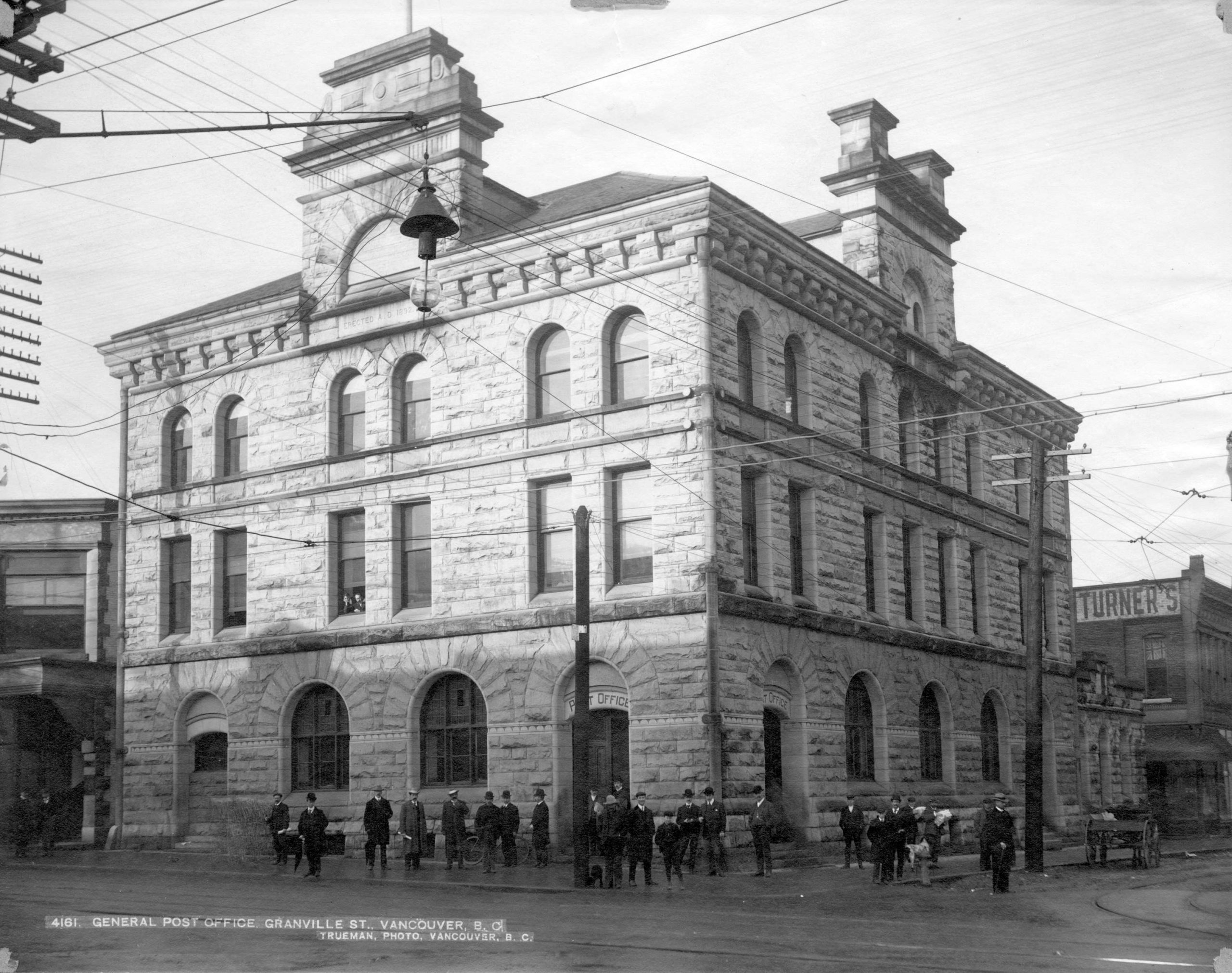
Above: General Post Office. Granville St., Vancouver, B.C. circa 1910
[Image: Vancouver City Archives]
*****************************************
You’ll note that these years include events listed under “Also in . . .” These are events for which we don’t have a specific date. If YOU know the specific date of an event shown there, please notify us . . . and cite the source! Many thanks!
*****************************************
February 9 A Vancouver banker, Ewing Buchan, had his version of O Canada sung at a meeting of the Canadian Club. Buchan’s lyrics will be very popular in BC, but will eventually be supplanted.
February 28 Vancouver’s main post office moved to the northwest corner of Granville and Hastings. Its new home had “Edwardian Baroque dignity, with columns, a clock tower and a granite facade.” Today it’s part of Sinclair Centre.
March 4 At Rogers Pass a CPR rotary snow plow and hundreds of workers were clearing snow and debris from an avalanche when a second avalanche swept down from above, killing 62.
March 11 Chief Joe Capilano died.
March 12 An explosion at a dynamite plant on Bowen Island kills five workers and is felt in Nanaimo.
March 25 The first airplane flight west of Winnipeg took place at Minoru Park in Richmond, with 3,500 spectators. Flying a Curtiss pusher biplane was pilot Charles K. Hamilton. On March 26 Hamilton flew from Minoru to New Westminster and back. He later challenged a racehorse to a one-mile race which, much to Hamilton’s embarrassment, the horse won by ten seconds.
March 31 James Edwin Machin, Vancouver’s first librarian, died.
April 20 A man in Surrey was fined $10 for speeding in his 1907 Marion car. He was travelling at 12 miles per hour.
May 6 King Edward VII died (and was succeeded by George V). The Vancouver chapter of the IODE (Imperial Order Daughters of the Empire) commissioned a fountain from sculptor Charles Marega in tribute to Edward. Today it stands next to the Art Gallery on the east side of Hornby Street.
May A “site commission” established by the provincial government began to tour British Columbia for a suitable site for the provincial university. They eventually chose Point Grey.
June The North Vancouver Yacht Club held its first long distance race for the Cates Cup, won by W.S. Buttar’s Ysidro.
July 4 W.G. McElhanney founded the engineering firm that bears his name today. The McElhanney Group of companies is a multi-disciplined firm with offices in western Canada and Indonesia.
July The name of Vancouver’s Westminster Avenue—so named because it led to New Westminster at the time—was changed to Main Street. (Its original name was False Creek Road.)
August 15 At Exhibition Park, the Vancouver Exhibition opened to the public for the first time. We know it today as the Pacific National Exhibition.
August 16 The Exhibition’s official opening was today, a ceremony presided over by Prime Minister Wilfrid Laurier. The Vancouver Daily News-Advertiser wrote, “Petrified women, sacrificial crocodiles from the sacred river Ganges, and dusky negroes who dodge swiftly thrown baseballs, to say nothing of the numerous Salome dancers, Spanish Carmens, Dutch comedians and chorus girls are some of the attractions being offered the visitors at the fair this week.”
Also in August Major-General Baden-Powell visited North Vancouver and inspected a gathering of local Boy Scouts.
October The first Annual Banquet of North Vancouver’s Board of Trade was held. Streetcars and a special ferry ran overtime for this occasion.
Also in October All-night street lighting began in North Vancouver.
November 9 We call it Central City Mission today, but when they laid the cornerstone today—in a driving rain—it was just the Central Mission. Clerics from a number of local churches were there. The Mission has since housed thousands and fed millions. On July 24, 1993, it moved from 233 Abbott St. to a new location at 415 W. Pender.
November 17 Anna Pavlova, the most famous dancer who ever lived, danced in Vancouver today. See the full story in our site’s Archives section.
November 23 The Royal Canadian Navy’s HMCS Rainbow steamed into Vancouver’s harbour this afternoon. She was the first RCN warship to visit the port, and the city gave her and her 189 crew members a big welcome.
November 24 “The management of the B.C. Electric Railway Company issued a call for tenders for its new passenger station and office block at the southwest corner of Carrall and Hastings streets . . .” Old-timers will recall the interurban cars actually running through the ground floor of that building, there to this day.
December 10 Father Edmond Maillard, after whom Maillardville was named, opened Our Lady of Lourdes Church there.
December 21 Hastings Townsite ratepayers vote to join Vancouver.
Also in 1910
The city of South Vancouver was incorporated. Its northern boundary was 16th Avenue.
A large grant from an Anglican Church conference held in London was given to establish a theological school in Vancouver.
An interurban railway was put through on the south side of the Fraser River expressly built to carry valley farm produce between New Westminster and Chilliwack.
Vancouver city police were agitating for a six-day week. The request was shelved.
Sacred Heart Catholic church, consecrated in 1884 at Ustlawn village, the Indian mission village in North Vancouver, had a second spire added during renovations this year and was rededicated as St. Paul’s. It’s a familiar north shore landmark to this day.
Fraser Mills became the Canadian Western Lumber Company. It would grow to become the biggest lumber company in the British Empire.
North Vancouver High School opened. For many years it was the only high school on the north shore.
Henry Thomas Thrift, Surrey’s municipal clerk, donated land for a new school building.
Kerrisdale Avenue was named at the request of Mrs. McKinnon, whose family had settled in that area in 1897. Kerrisdale was named after their home in Scotland, Kerry’s Dale.
Louis D. Taylor was first elected mayor. He would later make it a habit.
The name Ocean Park was chosen by the Rev. W.P. Goard for the development owned by his Ocean Park Syndicate, made up of prominent Lower Mainland Methodists wanting land for recreational and educational purposes.
The Cedar Cottage neighborhood got its name from an Interurban train stop there. The station, in turn, was named for the Cedar Cottage Brewery. Cedar Cottage has always been proud to be the only neighbourhood in Vancouver to have a lake. (Trout Lake.)
“Southlands,” a lavish Marine Drive mansion, was built for the wholesale grocer W.H. Malkin. It was the first built in that area.
Knox Presbyterian Church began services in the Southlands district. It would later become part of the United Church and change its name to Knox United.
The three-year-old City of North Vancouver had 5,000 residents.
Riverview Psychiatric Hospital opened in Coquitlam as the Hospital for the Mind, including Colony Farm, operating out of a hay barn on1,000 acres. Sixty patients were admitted the first year, working on the farm to provide food for themselves and staff.
The Interurban railway sparked growth at Innes Corners/Langley Prairie. It ran through the centre of what is now the City of Langley. The BC Electric substation here is admired by architects.
Glen Brae was built in Shaughnessy for lumber magnate William Tait. This striking building is known today as Canuck Place, a children’s hospice.
Fairacres was built in Burnaby as a home for realtor Henry Ceperly and his wife Grace. Since 1967 it has been home to the Burnaby Art Gallery.
The Vancouver Block went up at 736 Granville. Its lofty clock is a downtown landmark.
Architect Woodruff Marbury Somervell arrived in Vancouver from Seattle. Among the buildings he would design in the next few years: sugar king B.T. Rogers’ mansion, Shannon; the now-vanished Birks Building, the BC Electric building at Hastings and Carrall and the T-D Bank at Hastings and Seymour.
Sculptor Charles Marega created a bust of former mayor David Oppenheimer near the entrance to Stanley Park. (Oppenheimer had presided at the opening of the park.)
Columbia Bitulithic was founded and headquartered in Coquitlam. The company built roads throughout the province and was responsible for a lot of the Vancouver road network.
The 6th Field Company Canadian Engineers was established in North Vancouver.
A visitor to Vancouver’s east side reported that a “Piccola Italia,” or Little Italy, had been established in the area around present-day Main Street. There were about 1,000 Italians in Vancouver at the time.
B’nai B’rith was established in Vancouver.
The first interment at “The Old Cemetery” on Lillooet Road in North Vancouver.
The Oblate Fathers opened their third Vancouver church on 12th Avenue just west of Main Street in Mount Pleasant. Built in the neo-classical revival style, St. Patrick’s had twin cupolas and a grand entry portico with Ionic columns. That church has now been replaced with a newer building facing onto Main Street.
The Canadian Immigration Act specifically barred immigrants from India.
West Vancouver’s John Lawson donated land at 18th and Marine Drive for a building to house a church (Presbyterian) and Hollyburn School.
The north shore hospital moved to a bigger 15-bed building at 151 East 12th Street.
The Associated Charities of Vancouver started a West End Creche (as child-care facilities then were called).
The wood-hulled, steam-powered tug Haro was built in Vancouver for B.C. Mills (Hastings Mill) for its harbor service.
The Bank of Vancouver was established. It would go into liquidation just five years later, because it could not attract a significant deposit base.
The first B.C. Federation of Labour was formed. Twenty-six delegates, mainly from the Lower Mainland, pledged to seek the eight-hour day, favored industrial unionism and endorsed socialism. This federation would be disbanded in 1920.
Car dealer H. Hooper made a record automobile trip from Chilliwack to New Westminster in two hours and ten minutes. There were no roads as such.
Bob Brown, the man who would become known here as “Mr. Baseball,” bought the Vancouver Beavers for $500. He was the club’s owner, president, manager and shortstop.
Two sculpted lions were placed in front of the provincial courthouse in Vancouver. They were created by John Bruce, a Scot. Each weighed 15 tonnes, and cost $4,000.
An itinerant young English actor named William Pratt arrived in Vancouver. Among his earliest non-acting jobs here: carpenter at the Vancouver Exhibition. Later he would move to Hollywood and change his name to Boris Karloff.
Phyllis Munday, 15, began Vancouver’s first Girl Guide company with her mother.
Woodward’s held its first one-price sale day, 25 Cents Day, a forerunner of $1.49 Day.
The Dominion Building, one of the most visually distinct of all Vancouver’s buildings, was erected at the northwest corner of Hastings and Cambie. It was briefly the tallest building in the British Empire.